As I wrote in my previous post 'Nineteenth Century Day Jewellery', women of the nineteenth century were constantly instructed not to wear 'showy' jewellery during the day, often on the grounds of taste, marriageability, and morality.
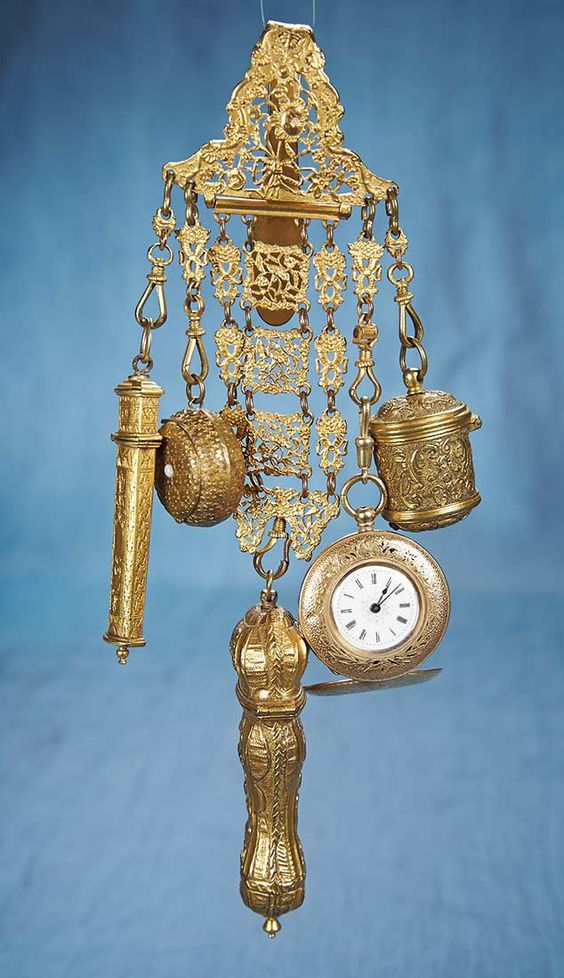
One way women who wanted to wear jewellery but still be 'in good taste' could get around this problem was by wearing ornaments that served a purpose - Chatelaines.
Chatelaines were originally the keys to the castle, worn in earlier centuries by the Lady of the castle, then later by the housekeeper of great houses. At a time when pockets in women's clothing were seen as symbols of privacy and secrecy, and depicted in paintings to symbolise a woman's private (sexual) life and therefore her immorality (!), the keys to the castle were worn on a chain fastened over the clothes around the waist. N.B. - I'd intended that to be a shorter sentence, and to provide a single link to explain. Turns out this is a larger topic than I'd remembered, and a single link won't be enough. Try here, here, or here, for some good articles on the history of women's pockets.
Thursday, 7 April 2016
Sunday, 8 November 2015
Nineteenth Century Day Jewellery
'A lady is never so well dressed as when you cannot remember what she wears.'
The moral subject of jewellery appropriate to wear during the day came up over and over again in nineteenth century books and publications aimed at teaching young women style and etiquette. Young women in Europe and America were expected to want to get married and then manage their husband's households, staying out of the public sphere. Young men were expected to want 'modest' (whatever that means) and quiet wives, someone who would be happy to stay home and raise their children. Most if not all etiquette and household management books used moral arguments against wearing large or 'showy' jewellery during the day, and many were aimed at the growing 'middle' class, people who were the first generation in their family to have a disposable income, and who were nervous of disposing of it incorrectly.
The new possibility for people to start with very little and make their fortunes, regardless of family or connections, was a massive social change from previous centuries. The aristocratic/wealthy classes of the eighteenth century had assumed that family, connections, property, and power all came together, and always would. The famous 'gilded age' and Louis 14th jewellery show off wealth and splendour on an enormous scale.
With 'new money' gaining access to property and therefore power, 'good society' (old money) retreated behind a wall of 'good taste', so that admiring or displaying wealth for wealth's sake became frowned on. Jewellery worn in the 1800s was supposed to be either inherited from past generations, or gifted from close family. It was also supposed to be an expression of the young woman's 'artistic' nature and good morals, - pieces were meant to be prized for their design and workmanship over the size or cost of the materials. Having said that, the materials were always to be of the best quality, never imitation gemstones or plated metal. Imitation jewellery was always said to be in bad taste, as it appeared to be falsely advertising wealth and status. The fact that a woman might wear gold plated pieces because they were very well designed, or because she didn't want to spend so much money on jewellery, doesn't seem to have been considered.
Two images of women wearing day jewellery, on the left, Judge Mary Margaret Bartelme wearing a cameo brooch, and on the right, 'The Children's Holiday: portrait of Mrs Thomas Fairbain and her children', by William Holman Hunt 1864-5, showing Mrs Fairbairn wearing a coral brooch and earring set.
The moral subject of jewellery appropriate to wear during the day came up over and over again in nineteenth century books and publications aimed at teaching young women style and etiquette. Young women in Europe and America were expected to want to get married and then manage their husband's households, staying out of the public sphere. Young men were expected to want 'modest' (whatever that means) and quiet wives, someone who would be happy to stay home and raise their children. Most if not all etiquette and household management books used moral arguments against wearing large or 'showy' jewellery during the day, and many were aimed at the growing 'middle' class, people who were the first generation in their family to have a disposable income, and who were nervous of disposing of it incorrectly.
The new possibility for people to start with very little and make their fortunes, regardless of family or connections, was a massive social change from previous centuries. The aristocratic/wealthy classes of the eighteenth century had assumed that family, connections, property, and power all came together, and always would. The famous 'gilded age' and Louis 14th jewellery show off wealth and splendour on an enormous scale.
With 'new money' gaining access to property and therefore power, 'good society' (old money) retreated behind a wall of 'good taste', so that admiring or displaying wealth for wealth's sake became frowned on. Jewellery worn in the 1800s was supposed to be either inherited from past generations, or gifted from close family. It was also supposed to be an expression of the young woman's 'artistic' nature and good morals, - pieces were meant to be prized for their design and workmanship over the size or cost of the materials. Having said that, the materials were always to be of the best quality, never imitation gemstones or plated metal. Imitation jewellery was always said to be in bad taste, as it appeared to be falsely advertising wealth and status. The fact that a woman might wear gold plated pieces because they were very well designed, or because she didn't want to spend so much money on jewellery, doesn't seem to have been considered.
Two images of women wearing day jewellery, on the left, Judge Mary Margaret Bartelme wearing a cameo brooch, and on the right, 'The Children's Holiday: portrait of Mrs Thomas Fairbain and her children', by William Holman Hunt 1864-5, showing Mrs Fairbairn wearing a coral brooch and earring set.
Subscribe to:
Posts (Atom)
©
Riches of nature and art | All rights reserved.

